
By [Author name – 要確認] | Last checked: 13 November 2026
18+ only. Gambling can be addictive. If gambling is causing you problems, call the National Gambling Helpline free on 0808 8020 133 (24 hours a day).
Disclosure: If you open an account through a link on this page, we may receive a commission. This doesn’t change the facts we report, and no operator paid to be mentioned. This article was drafted with the help of AI, then checked by our editorial team against official sources, including the Gambling Commission public register.
You’ve seen prices like 5/2 or 3.50 on a betting site and you’re not sure what they mean. Or a friend has mentioned an “each-way” bet or a “Lucky 15”, and the bet slip looks like it was written in code.
That’s normal. Betting sites assume you already know the language. If you don’t, it’s easy to place a bet you didn’t mean to, stake more than you planned or misunderstand how much you could get back.
What you’ll learn
- what a betting site does, and how to check it is licensed in Great Britain
- how to read fractional and decimal odds, and what they say about the chance of something happening
- the main bet types, from a simple single to an each-way bet and an accumulator, with worked examples
- how to place a small first bet safely, including the limits to set before you deposit
- a glossary of the terms you’ll meet most often
Betting is entertainment that costs money. Over time, the margin built into the odds means bettors as a group get back less than they stake. Nothing in this guide is a way to make money. It’s here so you understand what you’re doing before you spend anything.
How betting sites work: the basics for beginners
A betting site is an online bookmaker. It offers prices on the outcome of events, takes your stake and pays you if your selection wins. Before you look at a single price, it helps to know how the site makes money and who regulates it.
What a betting site actually does
A betting site does three jobs. It sets the odds for events such as football matches, horse races and tennis matches. It accepts bets at those odds through a bet slip. Then it settles the bets using the official result and the site’s rules.
Your agreement is with the company that holds the licence, not with the brand name on the screen. That company’s name and Gambling Commission account number should appear in the site’s footer and terms.
How bookmakers make their money: the margin
Bookmakers don’t need to know who will win. They build a margin into their odds. Every price can be turned into a percentage chance, and in a market with a margin those chances add up to slightly more than 100% (the odds section below shows how).
In practice, if you placed every possible bet in a market, you’d get back less than you staked. That is the bookmaker’s built-in edge, and it’s why betting should be budgeted like any other paid entertainment.
Bookmakers and betting exchanges: the difference
A bookmaker sets its own prices, and you bet against the bookmaker.
A betting exchange works differently. Customers bet against each other. One person backs an outcome (bets it will happen) and another lays it (bets it won’t). The exchange matches them and usually charges a commission on net winnings.
Exchanges have extra steps, such as laying and liability, so most beginners start with a standard bookmaker. If you try an exchange later, read its commission terms first.
Only use UK-licensed betting sites
In Great Britain, a betting site that offers bets to British customers must hold a remote betting licence from the Gambling Commission. On the Commission’s register this appears as Remote General Betting, usually followed by a type such as “Standard (Real Event)”. A licence means the site must, among other rules:
- check your age and identity before you gamble
- offer safer gambling tools such as deposit limits and self-exclusion
- block anyone who has self-excluded through GAMSTOP
- give you access to a free, independent dispute service (ADR) if a complaint isn’t resolved
Sites that advertise themselves as “non-GAMSTOP” or “no ID check” for UK players are not licensed in Great Britain. You’d lose these protections, so don’t use them.
How to check a licence in two minutes: find the account number in the site’s footer, search for it on the Gambling Commission public register, and check three things: a Remote General Betting licence shows as Active, the brand appears under trading names, and the exact web address appears under domain names.
Sources: Gambling Commission: Public register; Gambling Commission: Age, ID and financial verification
Three licensed betting sites we checked (examples, not a ranking)
To show what a licence check looks like, we looked up three well-known UK bookmakers on the Gambling Commission register on 13 November 2026. They’re listed in alphabetical order. This is not a ranking or a recommendation, and we haven’t tested their accounts or payments.
| Betting site | Licensee / UKGC account | Licence as shown on the register (13 Nov 2026) | Recorded regulatory action |
|---|---|---|---|
| bet365 | Hillside (UK Sports) ENC / 55148 | Remote General Betting Standard (Real Event): Active since 17 Oct 2019 | Settlement of £239,085, 4 April 2024 (anti-money laundering and player protection failings) |
| Betway | Betway Limited / 39372 | Remote General Betting Standard (Real Event): Active since 1 Nov 2014 | None recorded |
| Paddy Power | PPB Counterparty Services Limited / 39439 | Remote General Betting Standard (Real Event): Active since 1 Nov 2014 | Share of a £2,000,000 settlement by four licensees, 17 December 2025 (customer interaction failings) |
How to read the last column: a regulatory action is a public record that the Commission found failings and the business paid a settlement. In both cases above the licence was still active when we checked, so the site can legally take bets from British customers. A past action doesn’t tell you a site is unsafe today, but it’s worth knowing, and you can read the details on the register.
We haven’t listed welcome offers here, because we couldn’t confirm their full terms on the operators’ own pages on the day we checked.
Choosing a site for your first bet: any site that passes the licence check is legal to use. Beyond that, a beginner only needs three things:
- Easy-to-find limits: you can see where to set a deposit limit and a time-out before you deposit.
- A payment method you already use: your debit card or bank works for both deposits and withdrawals.
- The sport you follow: the site covers it and its rules page for that sport is easy to find.
Markets, odds and withdrawal speeds matter more later, once you know what you like to bet on.
Summary: A betting site is a licensed bookmaker that sets odds with a built-in margin. Before you sign up anywhere, check the account number, trading name and domain on the Gambling Commission register.
Sources: Gambling Commission public register: Hillside (UK Sports) ENC (55148), regulatory actions (55148); Betway Limited (39372), regulatory actions (39372); PPB Counterparty Services Limited (39439), regulatory actions (39439)
How to read betting odds: fractional, decimal and implied probability
Odds tell you two things: how much you’ll get back if your bet wins, and how likely the bookmaker thinks the outcome is. UK betting sites show odds as fractions or decimals. Many let you switch between them in the account settings.
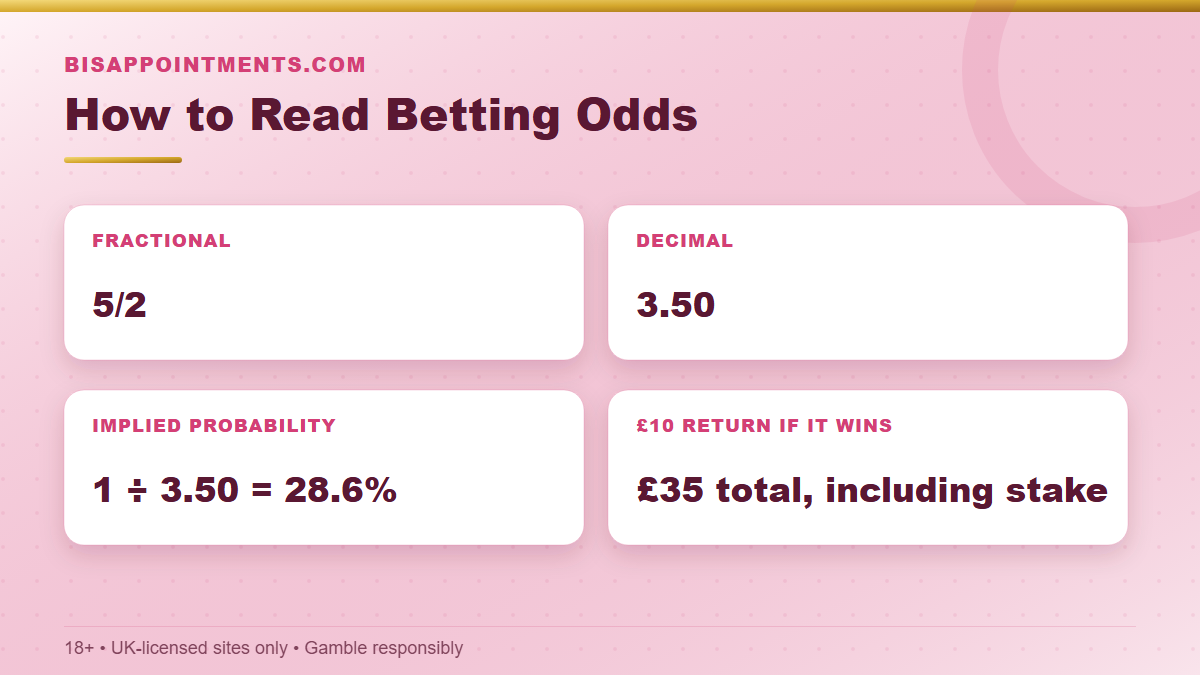
Fractional odds (5/2, 10/1, 4/6)
Fractional odds are the traditional British format, still used widely in horse racing. They show your profit compared with your stake.
- 5/2 (“five to two”): for every £2 you stake, you make £5 profit. A £2 bet returns £7 (£5 profit plus your £2 stake).
- 10/1 (“ten to one”): a £1 bet returns £11.
- 4/6 (“four to six”): for every £6 staked, you make £4 profit. A £6 bet returns £10.
The formula: return = stake × (top number ÷ bottom number) + stake.
Decimal odds (3.50, 11.00, 1.67)
Decimal odds show the total return for every £1 staked, including your stake. Many beginners find them easier because there’s only one sum to do.
- 3.50: a £2 bet returns £7.
- 11.00: a £1 bet returns £11.
- 1.67: a £6 bet returns about £10.
The formula: return = stake × decimal odds. Your profit is the return minus the stake.
Converting between fractional and decimal odds
To turn a fraction into a decimal, divide the top number by the bottom number, then add 1. For example, 5/2 = 2.5, plus 1 = 3.50.
| Fractional | Decimal | £10 bet returns | Profit on £10 |
|---|---|---|---|
| 1/2 | 1.50 | £15.00 | £5.00 |
| 4/6 | 1.67 | £16.67 | £6.67 |
| Evens (1/1) | 2.00 | £20.00 | £10.00 |
| 6/4 | 2.50 | £25.00 | £15.00 |
| 5/2 | 3.50 | £35.00 | £25.00 |
| 4/1 | 5.00 | £50.00 | £40.00 |
| 10/1 | 11.00 | £110.00 | £100.00 |
The figures show what happens if the bet wins. If it loses, you lose the £10 stake.
Implied probability: what the odds say about the chance
Implied probability turns odds into a percentage chance. With decimal odds: implied probability = 1 ÷ decimal odds.
- 2.00 (evens) → 1 ÷ 2.00 = 50%
- 5.00 (4/1) → 1 ÷ 5.00 = 20%
- 1.50 (1/2) → 1 ÷ 1.50 = about 67%
This is useful because it puts the price into plain terms. A selection at 4/1 is priced as roughly a one-in-five chance, so the bookmaker expects it to lose about four times out of five. Implied probability is the bookmaker’s estimate plus its margin. It’s not a fact about what will happen.
Odds-on, evens and odds-against
- Odds-on (for example 1/2 or 1.50): the outcome is priced as more likely than not. You stake more than you could profit.
- Evens (1/1 or 2.00): the profit equals your stake.
- Odds-against (for example 4/1 or 5.00): the outcome is priced as less likely than not. The potential profit is bigger than your stake.
The favourite is the selection with the shortest odds. An outsider (or longshot) has long odds. Short odds don’t mean a selection is safe. A 1/2 favourite is still priced to lose about one time in three.
Why the percentages add up to more than 100%
Add up the implied probabilities for every outcome in a market and you’ll get more than 100%. The extra is the bookmaker’s margin, sometimes called the overround.
Illustrative example (a made-up football match, not real prices):
| Outcome | Decimal odds | Implied probability |
|---|---|---|
| Home win | 2.10 | 47.6% |
| Draw | 3.40 | 29.4% |
| Away win | 3.60 | 27.8% |
| Total | 104.8% |
In this example, the extra 4.8% is the margin. Margins differ by bookmaker and market, and they’re often higher on markets with many outcomes, such as correct score. Comparing the total for the same match at different sites shows you which one is pricing it more tightly.
Starting price and price changes
Prices move as bets come in and news breaks. In horse racing, you can usually take a fixed price now or bet at the starting price (SP), the official odds when the race begins. If you take a fixed price, you keep it even if the odds later change. Some bookmakers offer extra price promises on racing. These are promotions, so read the terms on the day.
Summary: Fractional odds show profit against stake; decimal odds show the total return per £1. Divide 1 by the decimal odds to see the implied chance. The percentages across a market add up to more than 100% because of the bookmaker’s margin.
Types of bets on betting sites, from simplest to most complex
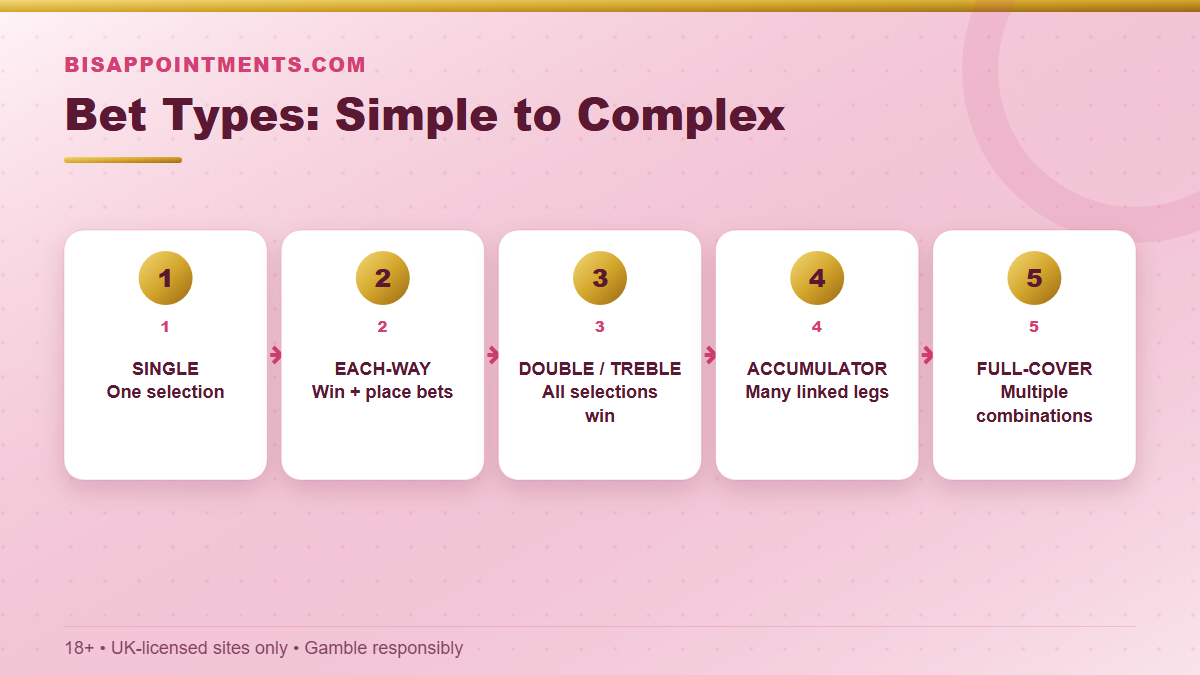
Bet types decide how many bets you’re placing and what has to happen for you to get a return. The more selections a bet needs to be right, the less likely it is to pay out. Start simple.
Single bets
A single is one bet on one outcome, such as “Team A to win”. If it wins, you’re paid at the odds. If it loses, you lose the stake.
Singles are the easiest bet to understand, and the one we suggest for a first bet. You can see the full cost and the potential return at a glance.
Each-way bets
An each-way (E/W) bet is two equal bets: one on your selection to win, and one on it to place (finish in the top few). It’s common in horse racing and golf.
The key thing beginners miss: a £5 each-way bet costs £10, because it’s £5 on the win and £5 on the place.
The place part pays a fraction of the win odds, set by the bookmaker’s place terms. For UK and Irish horse racing, bet365’s standard terms include:
| Runners in the race | Place terms |
|---|---|
| Fewer than 5 | Win only: the place half of your stake is added to the win bet, so a £5 each-way bet becomes a £10 win bet |
| 5 to 7 | 1/4 the odds, first 2 places |
| 8 or more (non-handicap) | 1/5 the odds, first 3 places |
| Handicaps with 12 to 15 runners | 1/4 the odds, first 3 places |
A handicap race is one where horses carry different weights to even out their chances. If you’re not sure whether a race is a handicap, check the race details on the site. This table shows only the common cases. Other race types and sizes have their own terms, some bookmakers offer extra places with different fractions, and the terms on your bet slip are the ones that apply.
Worked example: £5 each-way (£10 total) at 10/1, place terms 1/5, first 3. The place odds are 10/1 ÷ 5 = 2/1.
- Horse wins: win part returns £55 (£5 × 10 + £5). Place part returns £15 (£5 × 2 + £5). Total return £70.
- Horse finishes 2nd or 3rd: win part loses. Place part returns £15. You staked £10, so you’re £5 up.
- Horse finishes 4th or worse: both parts lose. You lose £10.
Now the same bet at 3/1: the place odds are 3/5, so a place returns just £8 on a £10 stake. At short prices, a placed horse can still leave you down overall.
Sources: bet365 Help Centre: Each Way Betting – Horse Racing (read through search excerpts)
Doubles, trebles and accumulators
A double links two selections in one bet. A treble links three. An accumulator (acca) links four or more. Every selection must win; if one loses, the whole bet loses.
The odds multiply, which is why the potential returns look big.
Worked example: a £5 treble at decimal odds of 2.00 × 1.80 × 2.50 = 9.00. If all three win, it returns £45. Multiply the implied probabilities (50% × 55.6% × 40%) and the treble is priced at about 11%, roughly a one-in-nine chance. Add more legs and the chance shrinks quickly.
Full-cover multiples: Trixie, Patent, Yankee, Lucky 15
These bets combine several selections into many separate bets, so you can get something back even if not every selection wins. The catch is cost: your stake is multiplied by the number of bets.
| Name | Selections | Bets included | Cost at £1 a bet |
|---|---|---|---|
| Trixie | 3 | 3 doubles + 1 treble = 4 bets | £4 |
| Patent | 3 | 3 singles + 3 doubles + 1 treble = 7 bets | £7 |
| Yankee | 4 | 6 doubles + 4 trebles + 1 fourfold = 11 bets | £11 |
| Lucky 15 | 4 | 4 singles + 6 doubles + 4 trebles + 1 fourfold = 15 bets | £15 |
Always check the total stake on the bet slip before you confirm. “£1 Lucky 15” means £15, or £30 if you make it each-way.
Common football markets
Football has dozens of markets. These are the ones beginners meet first:
- Match result (1X2): home win, draw or away win.
- Double chance: two of the three results in one bet, such as “home or draw”. Shorter odds, because it covers more outcomes.
- Draw no bet: if the match is drawn, your stake is returned.
- Both teams to score (BTTS): yes or no.
- Over/under goals: for example, over 2.5 goals means three or more goals.
- Handicap: one team gets a goal head start to even out the odds.
Most football match markets are settled on the result after 90 minutes plus added time. Extra time and penalties don’t count unless the market says so. Some markets, such as certain player markets, follow different rules. Check the market rules on your site.
Sources: bet365 Help Centre: Result/Events/Half-Time – Football Rules (read through search excerpts)
In-play betting, cash out and bet builders
- In-play betting means betting while the event is live. Prices change quickly, so it’s easy to bet more often than you planned. If you try it, decide your limit before the match starts.
- Cash out lets you settle a bet early for an amount the bookmaker offers. The bookmaker sets that amount from its current prices, which include its margin. It isn’t available on every bet, and the offer can change or be withdrawn while the event is live.
- A bet builder (also called a same-game multiple) combines several markets from one match into one bet, like an accumulator. Every part must win.
Bet types compared
| Bet type | Number of bets | What has to happen | Good first bet? |
|---|---|---|---|
| Single | 1 | One selection wins | Yes – simplest |
| Each-way | 2 | Win part: selection wins. Place part: selection places | Yes, once you understand the double stake and place terms |
| Double / treble / acca | 1 | Every selection wins | Not at first – low chance of a return |
| Trixie, Patent, Yankee, Lucky 15 | 4 to 15 | Varies; some bets can return with fewer winners | Not at first – costs multiply |
| Bet builder | 1 | Every part wins | Not at first |
Summary: Start with singles. Remember that each-way doubles your stake and that every leg of an accumulator must win. Full-cover bets multiply your total stake.
How to place your first bet on a betting site safely
Here’s the whole process, from setting a budget to getting money back out. It takes about 15 minutes, plus however long the site needs to verify your identity.
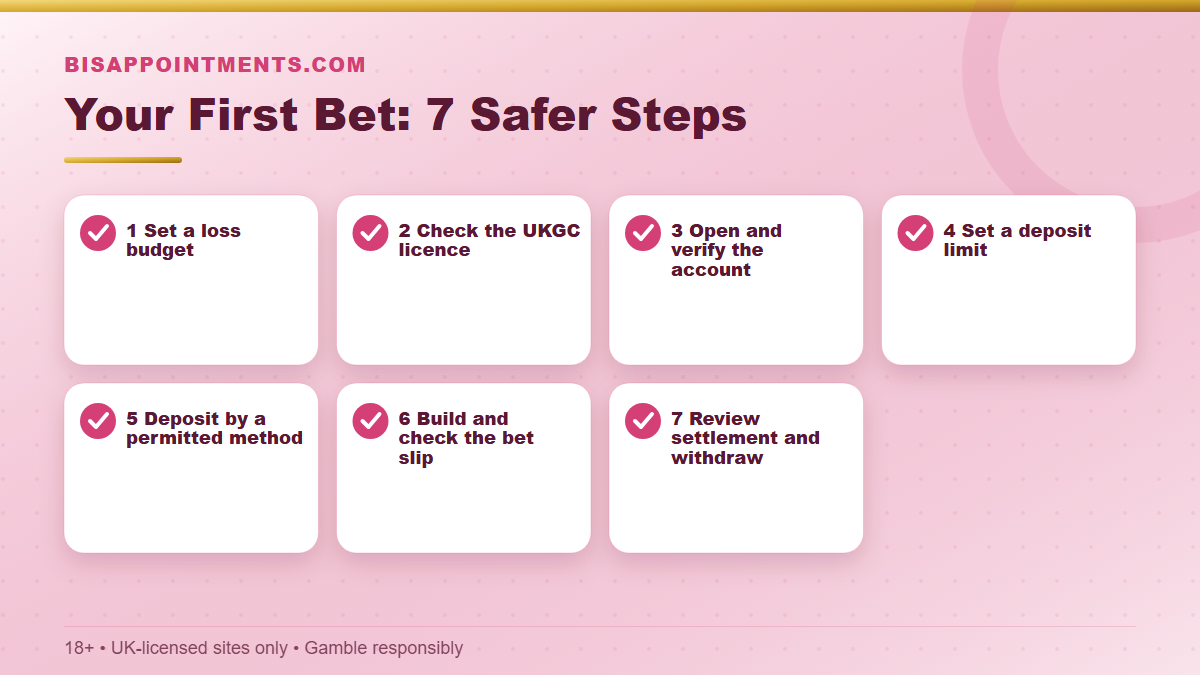
Step 1: decide a budget you can afford to lose
Decide how much you’re willing to spend on betting this month, before you open an account. Treat it like the cost of a cinema ticket or a match ticket: money spent on entertainment that you won’t get back.
Don’t use money meant for bills, rent or savings. Don’t borrow to bet.
Step 2: check the licence before you sign up
Use the two-minute check from earlier: find the account number in the footer, search the Gambling Commission public register, and confirm an active Remote General Betting licence, the brand name and the exact domain. If you’re choosing between licensed sites, use the three points under “Choosing a site for your first bet” above.
If a site has no account number, or the domain isn’t on the register, don’t sign up.
Step 3: open an account and verify your identity
You’ll give your name, address, date of birth, email and phone number. UK-licensed sites must verify your age and identity before you can gamble. They usually check your details against databases such as credit reference agencies and the electoral roll. If that isn’t enough, they’ll ask for documents, such as a passport or driving licence and a recent bill.
The Gambling Commission says a business can’t wait until you withdraw to ask for proof of age and identity it could have asked for earlier. That doesn’t mean you’ll never be asked for anything later. A site may still need more information when the law requires it, for example for anti-money laundering checks, and it should ask promptly rather than only when you withdraw. Having your documents ready and answering requests quickly helps avoid delays.
Sources: Gambling Commission: Age, ID and financial verification
Step 4: set a deposit limit when prompted
Since 31 October 2025, UK-licensed sites must prompt new customers to set a financial limit before their first deposit. Use it. Set the limit to the monthly budget from Step 1, or lower.
Decide the number while you’re calm, before you’ve placed a bet, so the limit reflects your plan rather than a decision made in the moment.
Sources: Gambling Commission: Changes to customer-led tools: financial limits
Step 5: deposit with a debit card or another permitted method
UK betting sites accept debit cards and usually other methods, such as instant bank payments or Apple Pay. Methods vary by site.
Credit cards can’t be used for gambling in Great Britain. The ban has applied since 14 April 2020, online and in person. Deposit only what you’ve budgeted, and start small.
Sources: Gambling Commission: Gambling on credit cards to be banned from April 2020
Step 6: build and check your bet slip
Tap the price next to your selection. It drops into the bet slip. Before you press “Place bet”, check:
- The selection and the market. Is it “Team A to win” or “Team A or draw”?
- The bet type. Single, each-way or a multiple? Untick any you don’t want.
- The total stake. For each-way and full-cover bets, the total is higher than the unit stake.
- The odds and potential return. Many sites ask whether to accept price changes. If you’re unsure, choose to be asked.
- The rules. For racing, note the place terms. For football, check how the market is settled.
When the bet is placed, you’ll see a bet receipt or reference. It’s listed under “My Bets” or a similar tab.
Step 7: after the event: settlement and withdrawals
After the result is official, the site settles your bet. Winnings are added to your balance. You can then withdraw them, usually back to the method you deposited with.
In the UK, betting winnings aren’t taxed for customers, whatever the amount. Tax is paid by the operators on their profits.
If you want a break, use a time-out rather than just deleting the app. A time-out locks the account for a set period.
Sources: Gambling Commission: Winnings from gambling for customers
Example: a £10 first weekend, worked through
This is an illustrative example, not a recommendation. Say your monthly betting budget is £10.
- You set a £10 monthly deposit limit when prompted, and deposit £10.
- You place two £2 singles on Saturday’s football and one £2 each-way bet (£4 total) on a race with clear place terms.
- That’s £8 staked. £2 stays in your balance, and you can withdraw it or leave it for later in the month.
- Whatever happens, you don’t top up this month. If all three bets lose, you’ve spent £8 learning how a bet slip works, and the most you can lose this month is the £10 you set aside.
- If a bet wins, decide before the weekend what happens to the winnings. The simplest rule is to withdraw them, so the money you can lose stays at the £10 you budgeted.
Writing the plan down before the weekend makes it easier to stick to.
Summary: Budget first, check the licence, verify your ID, set a deposit limit, deposit by debit card, check every line of the bet slip and stop when the budget is used.
Welcome offers and free bets: what beginners should check first
Most betting sites advertise a welcome offer, often free bets after a first qualifying bet. An offer can be useful for learning, but only if you understand the terms. You don’t have to take one.
How free bets usually work
A typical offer asks you to place a qualifying bet at or above minimum odds, then credits free bets. Terms vary a lot. Points that often catch beginners out:
- whether the free bet stake is returned with any winnings, or only the profit is paid
- the minimum odds for the qualifying bet and for the free bets
- payment methods excluded from the offer
- how quickly the free bets expire
- which sports or markets the free bets can be used on
UK rules on bonuses since 19 January 2026
Two Gambling Commission rule changes apply to every licensed site from 19 January 2026:
- Wagering is capped at 10 times. A wagering requirement is the number of times you must re-stake bonus funds before you can withdraw them. It can now be no more than 10 times the bonus. As a worked example, a £10 bonus with 10x wagering means placing £100 of bets first. The Commission’s announcement doesn’t mention free bets specifically, so check whether a free bet offer has any wagering in its terms.
- Mixed-product offers are banned. A site can’t make you take part in two types of gambling to get one offer, such as “bet on football, get casino spins”.
If you see a UK-facing offer that breaks either rule, don’t opt in.
Sources: Gambling Commission: Gambling promotions to be safer and simpler
The significant terms to read
Before you opt in, find these in the offer’s terms. The UK advertising rules treat things like the minimum stake, how to take part and any wagering as significant terms that must be made clear.
| Term | What to look for |
|---|---|
| Qualifying bet | Minimum stake, minimum odds, bet types allowed |
| Free bet value | How many free bets, and the value of each |
| Stake returned? | Whether the free bet stake is included in returns |
| Expiry | How many days you have to use the free bets |
| Eligible markets | Sports, markets and minimum odds for the free bets |
| Payment exclusions | Methods that don’t qualify |
| Wagering | None, or 10x or lower |
If you can’t find a term, ask customer support before you deposit. An offer should never push you to bet more, or more often, than you’d planned.
Common mistakes beginners make on betting sites
These are the mistakes that cost beginners most, and how to avoid them.
Building long accumulators
A small stake shows a big potential return, but every leg has to win. The treble example above was priced at about an 11% chance; six or eight legs are far less likely still.
What to do: keep to singles while you learn. If you try a multiple, keep it to two or three selections and a small stake.
Betting each-way at short prices
At short odds, a placed horse can return less than your total stake (£8 back on £10 at 3/1, as shown above).
What to do: work out the place return before you bet. If a place still leaves you down, a single may suit you better.
Not knowing how a market is settled
A late goal in extra time won’t count for a standard match result bet.
Tied finishes are often settled under dead-heat rules, which divide your stake by the number of tied selections. As a worked example, take a £10 win bet at 5/1 on a horse that dead-heats for first with one other horse. Half your stake (£5) is paid at 5/1 and returns £30; the other £5 is lost. You get £30 back rather than the £60 a clear win would have paid.
In racing, a late withdrawal can trigger a Rule 4 deduction from winnings on the other runners. The size of the deduction depends on the withdrawn horse’s price. As a worked example, if a deduction of 10p in the pound applied to £40 of winnings, your winnings would be £36 instead of £40. Your settled bet shows the actual figure.
What to do: read the rules for the sport and market on your betting site. If you don’t understand them, ask support or choose a simpler market.
Sources: bet365 Help Centre: What is a Dead-Heat? (read through search excerpts); Betway: General Rules (read through search excerpts)
Chasing losses
Chasing means betting more, or more often, to try to get back money you’ve lost. It’s one of the clearest warning signs of gambling harm. Losses are part of betting, and a bigger bet doesn’t make a return more likely.
What to do: when your budget for the period is used, stop. Use a time-out if you feel the urge to carry on.
Using unlicensed or “non-GAMSTOP” sites
Sites that target UK players without a Gambling Commission licence don’t have to follow UK rules on ID checks, safer gambling, complaints or self-exclusion. If something goes wrong, you have no access to a UK dispute service.
What to do: only use sites you’ve checked on the register.
Summary: Keep to singles, check the place return on each-way bets, read settlement rules, stop when your budget is gone, and stay with licensed sites.
Safer gambling tools on UK betting sites
Every UK-licensed betting site must offer tools to help you stay in control. Set them up on day one, while betting still feels new.
Deposit limits, time-outs and reality checks
- Deposit limits: cap what you can deposit per day, week or month. New customers are prompted to set one before their first deposit.
- Time-outs: lock your account for a short period, such as a day or a few weeks.
- Reality checks: pop-up reminders showing how long you’ve been logged in.
- Account history: shows your deposits, withdrawals and net spend. Sites with financial limits must prompt you at least every six months to review your account and transaction information.
The exact tools and periods vary by site. You’ll usually find them under “Safer gambling”, “Responsible gambling” or “Account limits”.
Sources: Gambling Commission: Changes to customer-led tools: financial limits
Self-exclusion and GAMSTOP
Self-exclusion blocks you from gambling with a site for a set period. You can do it on one site, or with every site at once through GAMSTOP, a free scheme covering gambling websites and apps licensed in Great Britain.
You can choose an exclusion from 6 months to 5 years, and set it to renew automatically. You can’t cancel during the chosen period. Betting shops on the high street are covered by a separate scheme, Gamstop Betting Shops.
Sources: GAMSTOP: About, Register
Financial checks you may notice
Licensed sites must carry out a light-touch financial vulnerability check when your deposits minus withdrawals go above £150 in a rolling 30 days. It uses public records, such as bankruptcy orders and county court judgments, and usually happens without interrupting you.
Sites may also ask for documents such as bank statements as part of anti-money laundering checks. These checks are a legal requirement, not a sign you’ve done something wrong.
Sources: Gambling Commission: LCCP condition 3.4.4 – Financial vulnerability check; Gambling Commission: Age, ID and financial verification
Where to get free help
If betting stops being fun, or you’re spending more than you meant to, free and confidential help is available:
- National Gambling Helpline: 0808 8020 133, run by GamCare, open 24 hours a day, every day.
- GambleAware (BeGambleAware): support and advice.
- GamCare: GamCare, which runs the National Gambling Helpline.
- GAMSTOP: self-exclude from all UK-licensed gambling sites.
Signs it may be time to talk to someone include betting to win back losses, borrowing to bet, hiding betting from people close to you, or feeling anxious when you can’t bet.
Sources: GambleAware: Get help now
If something goes wrong: complaints and ADR
Start with the betting site’s own complaints process. Give dates, times, amounts and any screenshots, and keep a copy of everything.
The business has 8 weeks to resolve your complaint. If it hasn’t, or you’re unhappy with the outcome, you can take it to the ADR (alternative dispute resolution) provider named in the site’s terms. ADR is a free, independent service.
Sources: Gambling Commission: Taking your complaint to an ADR provider
Bet safely: the UK rules in one box (November 2026)
- 18+ only. Licensed sites verify your age and identity before you can bet.
- Licence first: check the account number on the Gambling Commission public register.
- Deposit limit: you’ll be prompted to set one before your first deposit.
- No credit cards since 14 April 2020.
- Bonuses: wagering capped at 10x, and no mixed-product offers, since 19 January 2026.
- GAMSTOP blocks you from all UK-licensed gambling websites and apps.
- Need help? National Gambling Helpline: 0808 8020 133.
Betting sites glossary: the terms you’ll see most
Short, plain-English definitions for the words used on betting sites and bet slips.
Odds and prices
| Term | Meaning |
|---|---|
| Decimal odds | Total return per £1 staked, including the stake (3.50 = £3.50 back for £1) |
| Evens | Odds of 1/1 or 2.00: profit equals your stake |
| Favourite | The selection with the shortest odds |
| Fractional odds | Profit compared with stake (5/2 = £5 profit for every £2 staked) |
| Implied probability | The chance suggested by the odds: 1 ÷ decimal odds |
| Margin / overround | The bookmaker’s built-in edge; why a market’s percentages total more than 100% |
| Odds-against | Odds longer than evens, such as 4/1 |
| Odds-on | Odds shorter than evens, such as 1/2 |
| Outsider / longshot | A selection with long odds |
| Starting price (SP) | The official odds when a race starts |
Bets and markets
| Term | Meaning |
|---|---|
| Accumulator (acca) | Four or more selections in one bet; all must win |
| Ante-post | A bet placed well before the event, often days or weeks earlier |
| Back | To bet that something will happen |
| Bet builder | Several markets from one match combined in one bet |
| BTTS | Both teams to score |
| Double / treble | Two / three selections in one bet; all must win |
| Double chance | Two of the three match results in one bet |
| Draw no bet | Stake returned if the match is drawn |
| Each-way (E/W) | Two equal bets: one to win, one to place |
| Handicap | In football, a head start given to one side to even out the odds. In horse racing, a race where horses carry different weights for the same reason |
| In-play | Betting while the event is live |
| Lay | On an exchange, to bet that something won’t happen |
| Lucky 15 / Yankee / Trixie / Patent | Full-cover bets combining several selections into many bets |
| Place terms | The fraction of the odds and the number of places paid on the place part of an each-way bet |
| Single | One bet on one outcome |
Settlement and account terms
| Term | Meaning |
|---|---|
| Bet slip | Where you review selections, stake and potential return before placing a bet |
| Cash out | Settling a bet early for an amount the bookmaker offers |
| Dead heat | A tie; stakes are usually divided by the number of tied selections |
| Non-runner | A horse withdrawn before the race; bets on it are usually void |
| Returns | What you get back on a winning bet, including your stake |
| Rule 4 | A deduction from winnings when a runner is withdrawn late |
| Settled | When the site has decided a bet’s result and paid any returns |
| Stake | The amount you bet |
| Void | A bet cancelled with the stake returned |
| Self-exclusion | Blocking yourself from gambling for a set period |
Checklist: before your first bet
| ✔ | Question | Your answer |
|---|---|---|
| ☐ | Have I set a monthly budget I can afford to lose? | |
| ☐ | Is the site’s account number on the Gambling Commission register, with an active Remote General Betting licence? | |
| ☐ | Are the brand name and exact domain listed on the register? | |
| ☐ | Have I verified my identity before depositing? | |
| ☐ | Have I set a deposit limit at or below my budget? | |
| ☐ | Am I depositing with a debit card or another permitted method (not a credit card)? | |
| ☐ | Can I read the odds on my bet slip and work out the potential return? | |
| ☐ | Have I checked the total stake (especially for each-way and multiples)? | |
| ☐ | Do I know how this market is settled? | |
| ☐ | If I’m using an offer, have I read the qualifying bet, expiry and minimum odds? | |
| ☐ | Do I know where the time-out and self-exclusion tools are? |
FAQ
Q1. What are betting sites?
Betting sites are online bookmakers that offer odds on sports and other events, take bets and pay out on winning ones. In Great Britain, they must hold a remote betting licence from the Gambling Commission.
Q2. How do I read fractional odds like 5/2?
The first number is your profit and the second is your stake. At 5/2, a £2 bet makes £5 profit and returns £7 in total, including your stake.
Q3. What’s the difference between fractional and decimal odds?
They show the same price in different ways. Fractional odds show profit against stake; decimal odds show the total return per £1, including the stake. To convert, divide the fraction and add 1, so 5/2 becomes 3.50.
Q4. What does a £5 each-way bet cost?
It costs £10. An each-way bet is two equal bets, £5 on the selection to win and £5 on it to place, so the total stake is double the unit stake.
Q5. What’s the best bet type for a beginner?
A single is the simplest. It’s one bet on one outcome, so you can see the full cost and potential return at a glance. Accumulators and full-cover bets are harder to follow and less likely to return anything.
Q6. Do I pay tax on betting winnings in the UK?
No. The Gambling Commission says winnings from gambling are tax-free for customers, whatever the amount. Operators pay tax on their profits instead.
Q7. Why does a betting site need my ID?
UK-licensed sites must verify your age and identity before you gamble. They also check whether you’ve self-excluded. Doing it at sign-up helps avoid delays when you withdraw.
Q8. Can I use a credit card on UK betting sites?
No. Gambling with a credit card has been banned in Great Britain since 14 April 2020. Use a debit card or another method the site accepts.
Q9. How do I check that a betting site is licensed?
Find the account number in the site’s footer and search for it on the Gambling Commission public register. Check that a Remote General Betting licence shows as active and that the brand and web address are listed.
Q10. How can I stop betting if I need to?
Use the site’s time-out or self-exclusion tool, or register with GAMSTOP to block yourself from all UK-licensed gambling websites and apps. For free, confidential support, call the National Gambling Helpline on 0808 8020 133.
Summary
Betting sites are easier to understand once you know three things: what the odds mean, what your bet type needs to happen, and how much your bet slip really costs.
Key points:
- Check the licence first: use the Gambling Commission register to confirm the account number, trading name and domain.
- Read the odds: fractional odds show profit against stake, decimal odds show the total return, and 1 ÷ decimal odds gives the implied chance.
- Start with singles: each-way bets cost double the unit stake, and every leg of an accumulator must win.
- Set limits before you deposit: a budget you can afford to lose, a deposit limit and no credit cards.
- Know where help is: time-outs, GAMSTOP and the National Gambling Helpline on 0808 8020 133.
Ready to try your first bet? A few minutes of checks now means you’ll know exactly what you’re paying and how you’re protected.
- Check the site’s licence on the Gambling Commission public register.
- Set a deposit limit at or below your monthly budget when you sign up.
- Start with a small single, and read the bet slip line by line before you press “Place bet”.
Sources
Gambling Commission (public register and regulation)
- Gambling Commission: Public register
- Gambling Commission: Public register: Hillside (UK Sports) ENC (55148), Trading names (55148), Domain names (55148), Regulatory actions (55148)
- Gambling Commission: Public register: Betway Limited (39372), Trading names (39372), Domain names (39372), Regulatory actions (39372)
- Gambling Commission: Public register: PPB Counterparty Services Limited (39439), Trading names (39439), Domain names (39439), Regulatory actions (39439)
- Gambling Commission: Age, ID and financial verification
- Gambling Commission: Changes to customer-led tools: financial limits
- Gambling Commission: LCCP condition 3.4.4 – Financial vulnerability check
- Gambling Commission: Gambling promotions to be safer and simpler
- Gambling Commission: Gambling on credit cards to be banned from April 2020
- Gambling Commission: Winnings from gambling for customers
- Gambling Commission: Taking your complaint to an ADR provider
Support and self-exclusion
- GAMSTOP: About, Register
- GambleAware: Get help now
- GamCare: GamCare
Operators’ own rules pages (read through search excerpts; pages returned 403 to direct fetch)
- bet365 Help Centre: Each Way Betting – Horse Racing
- bet365 Help Centre: What is a Dead-Heat?
- bet365 Help Centre: Result/Events/Half-Time – Football Rules
- Betway: General Rules